
Sub-Micron Particle Shield for MEMS Sensors
Protect MEMS Pressure and Microphone Sensors From Contamination Without Blocking Signal
Gore ePTFE protective vent membranes block particles smaller than 1 µm from reaching MEMS sensor diaphragms while maintaining acoustic and pressure transmission fidelity — enabling reliable MEMS operation in consumer, industrial, and medical devices exposed to real-world contamination.
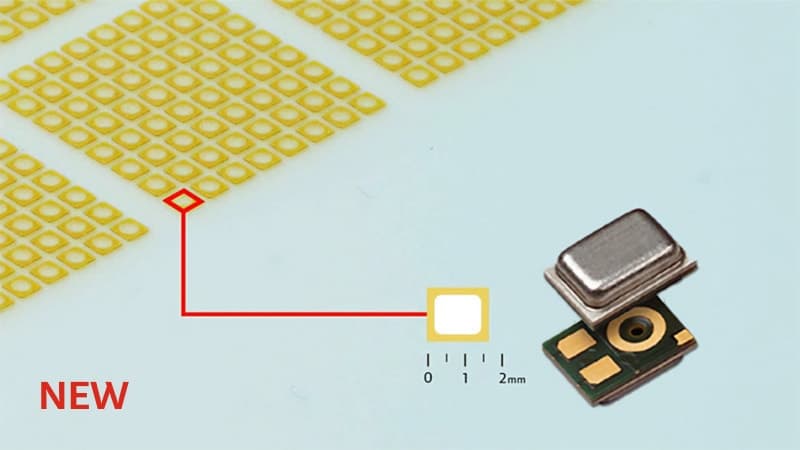
Protective ePTFE membranes shielding MEMS pressure and microphone sensors from particle contamination while allowing pressure and sound transmission. MEMS sensor diaphragms are fragile structures measured in micrometers — a single particle impact or adhesive contamination event can cause irreversible sensitivity drift or catastrophic failure. Gore's ePTFE membranes provide a physical barrier with pore sizes below 1 µm, stopping particles while the open microporous structure maintains high acoustic transparency for microphone applications and rapid pressure equilibration for barometric sensors. Available in adhesive-backed discrete parts and in reel format for automated placement.
Why Choose Gore MEMs Protective Vents?
Sub-1 µm Particle Exclusion
MEMS microphone capsules and pressure sensor diaphragms are vulnerable to particles far smaller than visible dust. Gore's ePTFE membrane pore structure filters particles below 1 µm, protecting against solder flux aerosols, fine dust, skin debris, and liquid-borne particulate in portable device environments — the contamination sources responsible for the majority of MEMS field failures.
High Acoustic and Pressure Transparency
Unlike solid protective coatings that degrade MEMS sensor performance, the microporous ePTFE structure presents minimal acoustic impedance to the sensor. Sound pressure waves and static pressure changes pass through the membrane with negligible attenuation, maintaining sensor sensitivity and frequency response within the design specification. Microphone SNR and pressure sensor resolution are preserved.
Adhesive and Reel Formats for Any Assembly Process
Gore MEMs protective vents are available as adhesive-backed discrete parts for manual or semi-automated placement, and in reel format for high-volume SMT-compatible assembly lines. The reel format enables pick-and-place application directly adjacent to MEMS sensor placement, minimizing handling exposure between membrane application and device sealing.
Technical Specifications
- Membrane Material
- Expanded PTFE (ePTFE)
- Particle Filtration
- < 1 µm pore size
- Acoustic Transparency
- High (low insertion loss)
- Mounting Method
- Adhesive-backed / reel (pick-and-place)
- Membrane Thickness
- Ultra-thin (application dependent)
- Liquid Resistance
- Hydrophobic — water and aqueous repellent
- Compatible Sensors
- MEMS microphones, barometric pressure sensors
- Supply Format
- Discrete adhesive parts / tape-and-reel
Applications
- MEMS microphone capsule protection in smartphones and TWS earbuds
- Barometric pressure sensor port protection in smartwatches and GPS devices
- Altitude and environmental sensor protection in wearables and IoT nodes
- Medical-grade MEMS pressure sensor shielding in portable diagnostic devices
- Industrial MEMS pressure transducer protection in contaminated environments
- Hearing aid MEMS microphone protection against cerumen and humidity
Industries Served
Part Numbers
Reference these part numbers when requesting a quote. Contact RSTECH Electronics for pricing, availability, and samples in Israel.
Part numbers sourced from gore.com. Custom configurations and additional variants may be available — contact RSTECH for details.
Frequently Asked Questions
What particle sizes do Gore MEMs protective vents filter?
Gore ePTFE membranes for MEMS protection have pore sizes below 1 µm, providing high-efficiency filtration of fine dust, solder flux aerosols, and biological particulate. This covers the particle size range responsible for MEMS diaphragm contamination in both manufacturing and field environments.
Does the membrane affect MEMS microphone sensitivity or frequency response?
The ePTFE microporous structure presents very low acoustic impedance. Typical insertion loss is below 1–2 dB across the audio frequency range, and the frequency response remains flat within specification. Gore provides acoustic characterization data for engineering evaluation.
Are Gore MEMs protective vents compatible with automated SMT assembly?
Yes. The reel format is designed for pick-and-place machine compatibility. Membrane placement can be integrated into the SMT assembly sequence immediately before or after MEMS sensor placement, minimizing the window of sensor exposure. Contact RSTECH for reel specifications and placement parameter recommendations.
Can these membranes be used on MEMS pressure sensors in medical devices?
Yes. Gore ePTFE is a well-characterized biocompatible material. For medical device applications, material certifications and regulatory documentation are available. Contact RSTECH Electronics to discuss medical-grade supply and documentation requirements for your specific device.
Ready to source MEMs Protective Vents in Israel?
Contact RSTECH Electronics — your authorized Gore representative in Israel.